Although there has been signs that spring will come, it still hasn’t made its presence known. Snow continues to fall and it lays in piles all over the place, but if you look carefully, there are a few small signs of spring.
There is one stretch along Bear Avenue where a large pine nestles against the white faux Tudor façade of a hotel. A tiny ecosystem has been formed by the southern exposure of the hotel, the shelter of the pine, and the white paint that reflects the sun back onto the pine. It is a small space, and I wouldn't have noticed it if it were not for the calls of the birds that live in the pine.
Normally, the only birds you see in Banff in the winter are ravens and magpies. But in this tiny ecosystem there are lively little sparrows cavorting and celebrating spring. This one tree is a very busy hub of activity. Plans are obviously being made, mates are being chosen, and directions are being given. You can hear this tiny little community from quite a distance. Some days, in my hurry, I forget about this spot, but the noise of the sparrows whistling and squawking, always makes me stop and stare at the tree.
The other day, I was watching all of the usual activity when I noticed tiny little flies and insects flying around the tree. This is the first insect life I have seen since I arrived. I was amazed that here, in town, mostly made by man, but accidentally made by man, rests this tiny ecosystem. So fragile and, yet, so alive.
Saturday, March 26, 2011
Friday, March 18, 2011
Second to Last...
I am getting into the second to last phase of my time in Banff. Tomorrow will be my second to last Saturday, and then Sunday will be… well you get the picture.
I was thinking about how impressive Banff can be in the winter—actually any time of the year, really. But if you spend enough time in one place, even Banff, you stop seeing it. You stop being present.
I imagine this is why I like the idea of travel, not that I always get to actually do it. But it is very attractive to go someplace, for a short time, to be present without struggling. You can see everything for the first time.
Going home too, enables you to feel present, but for a shorter time.
Saturday, March 12, 2011
Dispatch from Banff IV


Soon I will be leaving Banff and returning to Vancouver. It is nice to know that my time here is ending. I have enjoyed being here, I have skied (both Nordic and alpine), hiked-up a mountain, ridden a gondola, and steeped in the hot springs. I have taken advantage of the pool, free yoga, and mountain fitness activities. I have even curled, and tomorrow I will add a snow shoeing adventure to my list.
What I have found, is that no matter where you are, no matter how beautiful it all is, you eventually become used to it. I remember my first few weeks here, I was always stopping and looking up. My frequent stops would have been quite a hazard if the locals weren’t used to it. They just walk around you. Like they walk around the deer and the elk that line the streets some days.
A couple of weeks ago, I stooped taking photos, started walking around tourists and elk and deer. I had taken every photo that can be taken by a tourist. I had bought all the tolerable post cards. Even the night stars began to fade for me. That is sad. That is when it stopped being fun to be here.
Today, I booked my ticket home. Knowing that I am leaving has helped make the stars pop (as they say) and the mountains are once again, amazing.
Wednesday, March 09, 2011
Dispatch from Banff III
Last night the temperate increased by several degrees after days and weeks of temperatures sitting closer to minus twenty. I think I nearly suffocated in my bed last night, as the thermostat was set rather high, and when the outside temperatures went up, the heater started working.
The weather in this part of the world can change quite radically, especially if the Chinook winds come. I have heard that in Pincher Creek, Alberta, the temperature can go from minus-thirty to plus-ten degrees in under an hour. I can’t imagine what that would be like.
I read that the Chinook winds come from the warm ocean air from the Pacific Northwest. I find it almost poetic to think of how the winds traverse the mountains, to bring warm reminders of home.
I miss home. In my garden, spring has begun. The snowdrops are finished and the crocuses are nearly done too. The daffodils are getting ready to bloom. The garden needs manure, and the raspberry canes need to be pruned. Last year, I ate my first asparagus from the garden on April 5th.
It is hard to imagine spring will come to Banff. There are huge piles of snow everywhere and no sign that winter will ever end.
Sunday, March 06, 2011
Corn
I have been reading Michael Pollan’s The Omnivore’s Dilemma, which has made me think about how corn has, according to Pollan, colonized us. It is an interesting premise that a plant has used us in order to perpetuate its species.
Corn is everywhere and it is in everything we eat; it is in the feed of the dairy and beef cattle, it is in the chicken feed, and it is used in almost every processed food preparation. For a period of time, I developed food sensitivities and one of the chief suspects was corn. I tried to avoid corn, which I soon realized was absolutely impossible. Corn was even in my cosmetics and my toothpaste.
Pollan explains that corn is almost incapable of surviving without us. That the same reason corn is so attractive to us, its rich, large kernels, also means that it can’t easily reseed itself. When corn is left unharvested on a field, the thick outer husk prevents the seeds from scattering. If the husk lies on the ground and manages to sprout, the volume of seeds means that each sprouting kernel would suffocate the other. A neighbour grows corn in the back fields of the farm, each harvest a few husks are left on the ground, even though they have been planting corn there for several years, I have never seen one corn volunteer. Pollan estimates that if we stopped planting corn, it would only last one or two seasons before it died out.
An interesting question is, “How did corn become corn?
Saturday, March 05, 2011


Saturday, February 12, 2011
Mid-Point of my Banff Trip

It seems that I am almost halfway through my time at Banff. I wonder if, at the end of March when I am to go, there will still be snow on the ground? I hope not, I would like to see new life beginning before I go.
I would like to see more wildlife. So far, I have only seen mule deer, a mountain goat magpies and ravens. I have heard of elk sightings, but I haven’t seen any. I would really like to see a marmot and a mountain bluebird. I would like to see all the hibernating animals come awake, although I would like to see them from a safe distance.
Sometimes at night I can hear the coyotes, and people tell me about seeing wolves. I wish to see all these creatures before I leave.
Sunday, February 06, 2011


Sunday, January 23, 2011


Saturday, January 22, 2011
Dispatch from Banff
Right outside my window, they tell me, is a swamp. I cannot see it for myself, because the swamp is covered in snow. But I can imagine there is a swamp because the trees are a little undersized and many are in the long, slow process falling over. Each year, the trees slowly fall over. Too slow to be visible, but I assure you, they are still falling.
There is too, the conifer trees that are not evergreens. They look like evergreens but they are actually larch trees in the needle-like drag of the conifer. A deciduous tree. A liar.
Last night, I saw a deer. It stood outlined by the light of the street. I stopped and stared at it for some time. It did not look at me once. This morning, I went on a hike, and I found large chunks of fur on the path. At first, I thought it was grass as it was short and the colour of dry grass. The texture also suggested dry grass, but when I touched it, I realized it was fur.
Tuesday, January 11, 2011
Short Ears
For the last three or so years, we have spotted a short eared owl prowling along the banks of the canals. The owl seems to appear in late fall and stay around until early spring. Unlike most owls, the short eared owl often hunts in the daytime. Sometimes, when we are walking along the bank, the owl will suddenly rise-up, right in front of us, and fly right over our heads.

For the last

For the last
Garlic: Phase 2


I just received some organic Russian red garlic. It has such beautiful cloves. large and tasty! I decided to plant most of the cloves in the garden, even though the ground is a little frozen. I am not sure how they will turn out--if they will turn out! Anyway, fingers crossed.
Wednesday, January 05, 2011
The Sky is Falling
I have been reading Birds and Bees, Sharp Eyes, and Other Papers (N.D.) by John Burroughs. Burroughs (1837 to 1921) was a naturalist and essayist much influenced by Emmerson and Whitman. Birds and Bees …is courtesy Project Gutenberg, and I am reading it on my iPod. It seems odd to read a book on nature on such an unnatural device but this is the modern world after all.
Burroughs has a lovely, sometimes purple way of describing nature. I think his tendency to the descriptive is both a strength and a weakness of his writing. His work is detailed, employs a lot of metaphor and simile, and sometimes ventures down the purple path, but it is also very fitting for this style of writing. Reading Burroughs is like taking a walk with him as he describes the natural world. You experience nature as he does. Walking through his orchards, his dog ambling along at your side, and the ever present shot gun in case one encounters a red squirrel which he seems to have roundly hated.
Anthropomorphism is the cornerstone of his writing, something a modern naturalist is trained to avoid, although I do not think that they ever achieve the impartial observations they claim. Burroughs is definitely not of the Skinnerian school of animal study. I like Burroughs way of endowing his subjects with human qualities, because it reveals much about the writer and even helps the animal to become alive on the page. A media theorist I recently read, refers to animals as technology, and I much prefer the naïve humanist quality appropriated by Burroughs to describe his world, than the careless theoretic use employed by modernist theorists. But Burroughs does not have the transcendental quality of Emmerson or Thureau, nor the inspirational quality of the art of Whitman, rather his work is transportational (perhaps escapist).
Burroughs writing reveals a very active, sometimes combative naturalist. He is often irritable, especially when defending a bird. He rightfully hates the human plunderers of nests and birds, and, sadly, he shoots the non-human plunderers. Sometimes I wish that he would have reversed his policy. Burroughs reports his repeated and failed attempts to intervene with nature. Shooing cow birds away from nests, only to discover them back the next day. Finding grounded fledglings and putting them back into the wrong nest, where the fledgling then terrorizes and kills the residents. Something all students of nature have encountered, and have repeatedly tried to beat the odds, always failing.
What is surprising is the number of species that Burroughs documents. He lists a number and variety of species that we could not hope to encounter eighty years after he has written about them. Burroughs orchard is chock-full of birds, although he reports very low survival rates, estimating only one in ten fledgling survives.
I consider these terrible odds of bird species from only eighty years ago and then reflect on the birds that are now killed en mass. Most recently, thousands of birds have fallen from the sky in North and South America. Consider too, that every year thousands of migratory birds are killed by the tailing ponds of the tar sands, high rises, wind turbines, poor farming practices and other industries.
When British naturalists came to Canada, they reported that the sky was covered by a thick canopy of birds. Now we can look up and see a sky, empty of its former inhabitants.
Tuesday, January 04, 2011
Going Away


I have been back from the farm for four days and I am already looking forward to going back in three days. This is typical. I always wish I was at the farm instead of in my inner city apartment.
This next visit will be different, because it will be the last weekend I go to the farm for quite some time. I am moving to Banff for a while. I am not sure how long. It may be I am gone for three months or maybe longer. I keep ticking the time off in my head in terms of gardening. I will miss the garlic as it starts to reach its green tips into the sky. I will miss pruning the raspberries, and liming the patch to prevent cane rot. I will miss turning over the next year's compost, nor will I be able to manure the garden. Fortunately, I am not the only gardener.
I will miss looking for the first snow drops and crocuses. Sugaring the first violets, and then never using them. I will miss seedy Saturday and they may miss the money I spend on oddly coloured varieties of vegetables.
But mostly, I will miss my family and friends.
Tuesday, December 28, 2010
One Cup
For Christmas I was given a book, Canning, Freezing, Storing Garden Produce (1977) published by the US Department of Agriculture. It is an excellent guide. I highly recommend it. It isn’t over cautious like many of the books of this kind, and it explains some of the reasons why you should heat process pickles (something I haven’t done but I will consider doing now).
Like all books of this kind, it talks a lot about botulism. Botulism occurs when non-acidic fruits and vegetables are not processed correctly. In this guide they say that one cup of botulism is enough to kill the entire world. It reminds me of a home economics class. The instructor said that one cup of licorice extract was enough to colour the great lakes.
Just one cup and the world ends and the lakes turn a waxy black shade.
Tuesday, December 07, 2010
A Gardener's Lament

When I look at my garden I see the skeletal remains of the bean house looming over me. All my dahlias are dead, they are blackened and leaning over some are lying prone on the ground.
I am pursued by regret. I should have picked their last flowers. Now, there are no more flowers left in the garden. What about my frozen kale, leeks and broccoli. Will they survive? Should I have covered them? Why did I fail them so?
My larder is empty. All the potatoes are gone. There is no more fresh fruit or vegetables to pick from the garden. I must now shop for my greens, and even in the stores, the only good choices are the cole crops and girl cannot live on cole alone. I know this because I have tried.
And the sky is grey.
Tuesday, November 30, 2010
The Return of the Kingfisher

The kingfisher is back! For years the kingfisher was a permanent resident of the farm, and then he disappeared about five years ago. I missed seeing him perched on the wire over top of the canal. Last year, we thought we heard him, but we couldn't spot him. Then this weekend, we kept hearing him, and then we finally spotted him. What a delight it was to see his bright blue body flying across the green canals.

Sunday, November 21, 2010


Tuesday, November 09, 2010
Snow Goose
 The snow geese came through in large flocks in the late fall. The would stay in the back fields, eating the corn leftover from the harvest. When I walked too near them they would all take flight. Then I would be surrounded by these large white birds, winging around me.
Snipe!
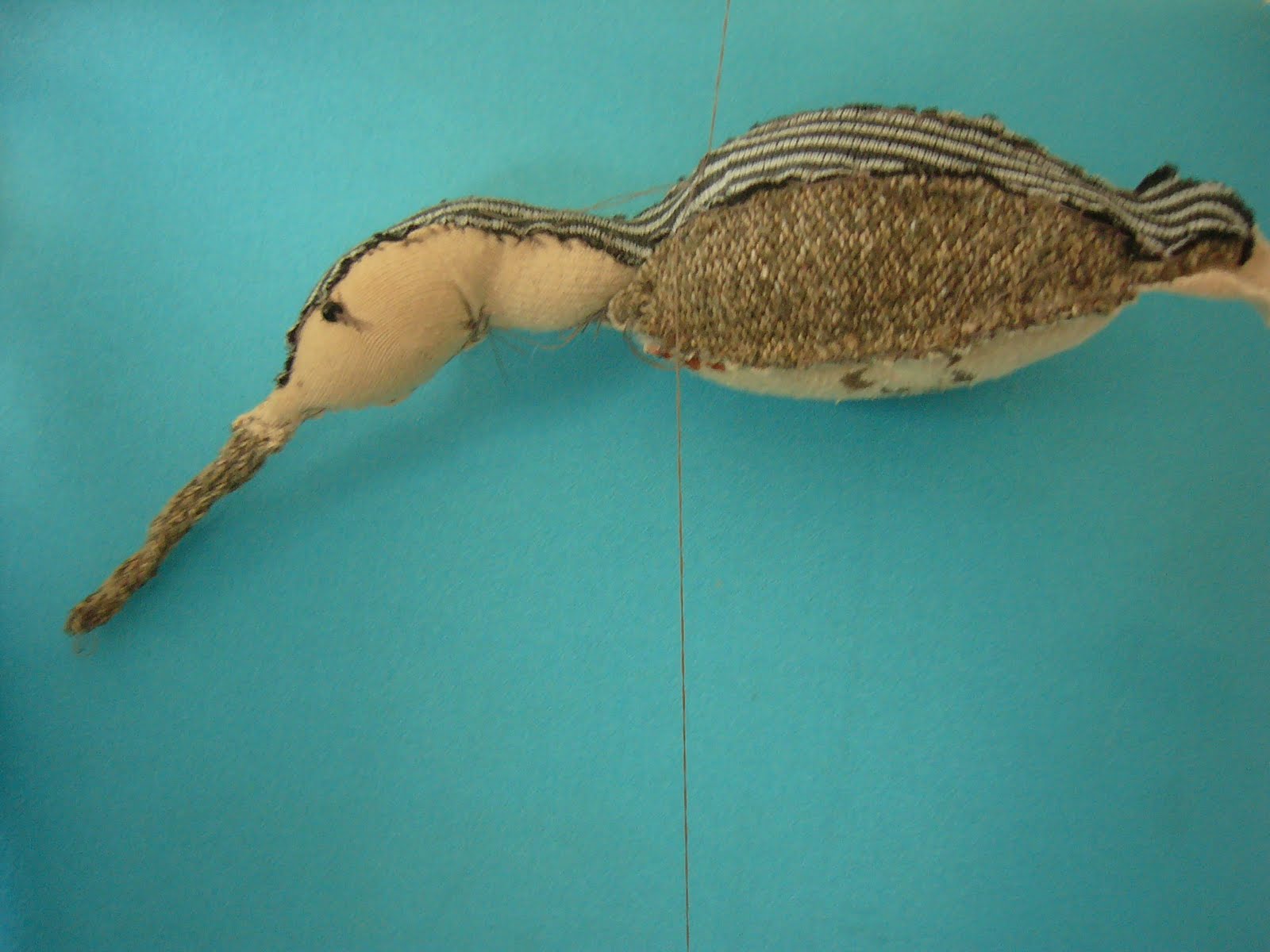 This fall we have encountered several snipes at the farm. They have a very distinctive call, hence their name. Even if you don't hear their call, you can identify a snipe by its weird zig-zag flight pattern.
 People still hunt snipe although they are very tricky to shoot. I try not to think about that too much.
Let me presnt the Pelicans

 I was so impressed by the pelicans summering at Floating Stone lake in northern Alberta that I had to make them. They are amazing birds. Huge. Beautiful. I have never seen anything quite like them.
When I look at these birds, I remember floating on the warm lake water, as a flock of pelicans flew so close overhead, I could almost touch them.
Sunday, November 07, 2010
Garlic Season

I finally got around to digging-up the garlic patch, and today, I planted three rows of garlic. I used last year's garlic, although I was sorry I didn't get any new stock this year. Last year's crop was a little weedy looking. The cloves are a little on the small and thin side. It is still good, but I worry that the small cloves will yield an even weedier crop next year.
Hops

We just harvested the hops. We have a patch of golden hops growing against the back fence line. It takes some doing to cut a path through the blackberries to get to the hops, but well worth the effort. I usually incorporate hops into my French bread recipe. I like to make a hops tea and then use the warm hop infused water to proof the yeast. I ran out of hops in the spring so I have been experimenting with other teas but so far, hops are the best!
There used to be lots of hops fields in this area. They would grow hops on tall trellises that stood 12 feet high (so I am told). It became too expensive to keep up the trellises and farming hops is not as common around here. But I still like to imagine fields of giant trellises stretching up to the sky.
The Fall Garden

It was time to clean-up the garden. For most of the plants, the season has ended. The beans and the corn are done. All that's left is the kale, next spring's broccoli, and some spinach. As you can see in the picture above, I dug-up all of the plants.
 Then we dismantled the greenhouse and harvested that last of the tomatoes. It is November after all, and we should have tomatoes ripening until the start of December. We take the greenhouse down, because we have lost a couple of greenhouses to the November winds. Scot built the greenhouse so that it comes apart fairly effortlessly. The most difficult part is getting the tomato plants out and making sure that there are no tomatoes left. Otherwise you can get all sort of pests and blight. Ideally we should move the greenhouse but it isn't that feasible.

The last of the tomatoes!
Monday, October 25, 2010
The Birds


I am amazed by the number and variety of birds that have been flying around the farm these last few days. I guess it is the combination of the harvest attracting some birds, and the birds that are flying south are coming through now too. When I look up, the sky is filled with birds. They fly in silhouette against the sun, and it looks a little like black writing across the blue sky. The birds fly at different heights, and I try to read their flight. What kind of birds are they? Are they traveling alone or in a group? Are they migrants or local? So far, I have seen white geese, Canadian geese, crows, harriers, falcons, eagles, herons, snipes, and all sorts of ducks.
I imagine, this life-filled sky is a little bit like what it must have been like, before we settled here and displaced them.
Monday, October 18, 2010
Fall at the farm

Cranberry season is happening. A sure sign that winter is not too far away. So far the weather has been very kind. Lots of sunny days and not too much wind. Best of all, there have been very few frosts. If you are knee deep in a flooded field, you can come to appreciate how depressing it is to break the ice on the water before you jump in.
The Eagles Have Returned

The Eagles disappeared for most of the summer. They did not use their nest. I am pretty sure they did not have a brood this summer. Instead they disappeared for weeks at a time and then returned for short periods. They did have three eaglets last year, so perhaps they were taking some time off? Do eagles do that?
While the eagles were gone, all sorts of raptors came to fill in the void. We saw harriers, red-tails, and a falcon or two. When the eagles come back, the smaller raptors tend to move on. Anyway, it seems the eagles are back. Soon they will be fixing their nest for next year.
Thursday, September 30, 2010
My Mother's Camera

I inherited my mother's new digital camera. It took a few months for me to look at it, and when I did, I discovered the last pictures she had taken before she died. Most of the photos were experiments, as she tried to get the focus and figure out all of the tricks. Lots of photos of grandchildren and her dog.
I think she must have known she was going to die, because before she went into surgery, she flew to Manitoba to see her mother. She and my grandmother went to visit the town where my mother grew-up. When I looked at the camera's memory card, I found dozens of bird photos!
I realized then that we had more in common than I had thought.
Tuesday, September 21, 2010
More canning of Tomatoes

I forgot to mention in the Gorilla Canner recipe for tomatoes, when canning the tomatoes you need to pack them down, so that they will seal properly.

From the Garden
 The world' largest fennel! I discovered the secret to sizing up fennel bulbs this year, and it is all in the transplating of the seedlings. You must start the plants and then transplant them, otherwise the tend to grow up, not out.
 The late corn is just about ready. Beside it, the remaining raspberries are all suffering from cane blight. I have been cutting out the blighted canes and it looks like they are all blighted. Worried about next year's crop.
 The fall garden is slowly finishing. The summer squash are almost done. Everything is now grown. Already, a plan is forming for next year.
Thursday, September 02, 2010
How to be a successful Canner: Gorilla Style

1. You will need to skin and core the tomatoes before you can them. Just drop the tomatoes in boiling water for 30 seconds and then place in a cold water. The skins should peel away very easily. Allow two tomatoes per jar (depending on size).
 Once the tomatoes are prepped, you will need:
- large canning pot (big enough to hold four or five jars and tall enough to cover jars with water and allow it to boil).
-one sauce pan to heat lids
-four or more wide mouth or narrow mouth jars, sterilized (place in oven for 10 minutes at 225 degrees).
-lids and rings to match
-lemon juice and coarse salt
1. Place the tomatoes in jar. Squish the tomatoes down and run a knife along the insde of the jar to remove trapped air. Fill the jar to about 1/2 an inch head space.
2. Add a tbsp of lemon juice and a 1/4 tsp of salt to each jar. The salt is for flavour (optional) but the lemon juice is to bring-up the pH. So use prepared lemon juice in order to be sure you have the right pH.
3. Clean the top of jar. Place lids in simmering water. Do not overheat the lids. Just heat enough to make the rings soft. Place lids on jars and screw-on the rings. Screw rings until they are just tight and then back-up a quarter of an inch. The rings should not be too tight.
4. Place jars in the canner. Top-up with warm water, cover jars and then put cover on pot. Bring to a boil and let boil for 20 minutes.
Wednesday, September 01, 2010


Tuesday, August 03, 2010
Canning Peaches
I was just passing through the Okanagan on a week-long roadtrip, so I thought I would pick-up some fresh fruit along the way. It seems such an odd year for growing. Everything is ready all at once. I knew cherries were available as well as apricots but peaches and nectarines were ready too. I even found some freestone peaches, which is really early.
My peach canning recipe
I use a hot water bath for the peaches. And my canner fits four wide mouth jars at a time, so I will give a one batch recipe.
Equipment
4 wide mouth canning jars sterilized, rings and lids, and ready to go
(To sterilize the jars, you palce them in the oven at 250 degrees F for ten minutes.)
To peel peaches:
1 canner (fill half the canner) bring to a boil
1 bowl of ice cold water
1 small pot half filled with hot water for heating lids
Ingrediants:
6 or seven freestone peaches (1 1/2 per jar is the general rule although this changes with size)
2 cups of sugar
8 cups of water
1. Use a large pot and add the sugar and the water, and bring to a boil over high heat. Stir constantly. Allow syrup to bil and then turn off the heat.
2. Bring the canner to a boil. Place peaches in the boiling water for 30 seconds or so. Do not cook peaches. Once the peaches are ready place them in ice cold water. The skin should peel away very easily. If not then you need to leave them in the scalding water a little longer. Peel the peaches and cut them in half. Use the knife to pry the flesh away from the pit.
3. Place peaches in jar and cover with syrup immediately so that the peaches do not brown. You can add a little at a time. Do not overfill. Allow 1/4 of an inch head room at the top so that the lids will seal.
4. Place lids in a small pan filled with hot water (almost boiling). Do not boil the lids.
5. Once the jars are filled, clean the rims with a clean cloth so that the lids will seal. Place a lid on the jar, put on the ring and screw it on but not too tight.
6. Add some cold water to canner so that the level rises to around 3/4 of the way and so that the liquid is not too hot. Add the jars. Make sure the water just covers the lid. Boil for 15 to 20 minutes.
7. Place hot jars on a dry cloth and allow to cool down. Keep away from open windows, as cold temperatures will cause the jars to crack. You should hear the lids "pop" as they cool down and seal. It is pretty easy to tell if the lids have sealed by tapping on them (when they have cooled). Remove the rings, clean the jars, label them, and place in a cool dry place for eating when peaches are out of season. Enjoy.
Monday, July 12, 2010
The Summer Garden

Finally, the peas are ready, the cherry tomatoes are just starting, the strawberries are almost finished, and the raspberries were a bust. The beans in the bean house are now climbing their poles. The garden is looking very good.
I am disappointed by the champion of England pea seeds. They are vigorous but the peas themselves are tiny and not very tasty. The Mr Vans are amazing tall and big pods with tasty peas. Waiting on the Manitoba peas but I think they may be small but they are also very vigorous..
The soya beans took, with a catch of about 70% which is better than in past years. The sunflowers never germinated, so have to buy some seeds next year. I liked the West Coast seed variety pack (usually I don’t go for that kind of thing but these were pretty good and they kept you guessing).
The zuccinni are producing now and soon we will be buried under an avalanche of them.
Monday, June 28, 2010
Strawberry Season and Pesticides
Strawberry season is now open and, in fact, will have reached its peak by the end of this week. I love strawberries and I usually freeze quite a few bags of them in order to get through the winter, but according to EWG, strawberries are now in the top twelve fruits and vegetables you should not eat unless they are organic.
From Mother Jones (http://motherjones.com/blue-marble/2010/03/econundrum-12-most-contaminated-fruits-and-veggies)
In descending order, the EWG's 12 most contaminated fruits and vegetables:
1. Peaches
2. Apples
3. Sweet bell peppers
4. Celery
5. Nectarines
6. Strawberries
7. Cherries
8. Kale
9. Lettuce
10. Grapes (imported)
11. Carrots
12. Pears
For the full list of all 47 fruits and veggies, go here.
Wednesday, June 16, 2010
Solstice
Almost at the summer solstice. It is hard to believe that summer will ever come. The weather has been unseasonably cold and wet. The garden is growing but the fruit will not set or if it does, it will be watery tasting. The fruit needs the sun to sweeten it. I feel, like I need the sun to chase away the grey.
Quail

I spent a few days on Salt Spring Island. It was a little wet and cold but pretty manageable. Good weather for hiking but not so good for swimming. The island was swarming with quails, a most improbable looking bird.
Thursday, May 27, 2010
Garden Update

The garden is looking pretty good right now. It is that perfect time when you have prepared the ground and the plants are coming up, but the weeds haven't caught up yet. Next weekend, I bet that this situation will have changed and there will be plenty of weeds to occupy my time. I noticed tiny little dill plants starting to volunteer all over the place. I never have to seed it down, it just seeds itself. If only all gardening was this easy.


Subscribe to:
Posts (Atom)